Exploring the Rich Tapestry of Food Culture
Food is never just food. A plate of poha at breakfast, biryani at a wedding, litti chokha on a winter afternoon, or payasam served after a festival meal all carry stories. They speak of climate, trade, migration, caste and community, memory, faith, work, celebration, and survival.
Food culture is the way people grow, cook, share, value, and remember food. It includes grand feasts and humble snacks. It lives in spice boxes, street carts, temple kitchens, lunch dabbas, family recipes, and the quiet rules of hospitality. In India, where food can change every few kilometres, this culture is especially rich and layered.

Food begins with place
Every cuisine starts with geography. What grows nearby, what keeps well in local weather, and what people can afford all shape daily meals.
Coastal regions often build meals around rice, fish, coconut, kokum, tamarind, or dried seafood. In drier areas, millets, pulses, ghee, pickles, and sun-dried ingredients play a larger role. Mountain foods may favour grains, fermented items, warming spices, and filling broths. Floodplains support rice, leafy greens, fish, and seasonal vegetables.
This is why food feels so closely tied to home. A dish carries the taste of soil, water, weather, and local labour. The same vegetable can taste different across regions because the cooking fat, spice blend, souring agent, and texture all change.
Take the simple idea of dal. It may appear as thick arhar dal with a tempering of garlic and cumin, a thin rasam-like preparation with tamarind and pepper, a creamy dal makhani, a mild moong dal, or a Bengali cholar dal with coconut and whole spices. Each version answers a local need and reflects a local taste.
Place decides the ingredients. People decide the meaning.
Memory is one of the strongest flavours
Many people remember food before they remember words. The smell of ghee on a hot phulka, mustard oil in a pickle jar, curry leaves crackling in a pan, or jaggery melting into kheer can pull a person back to childhood in seconds.
Family recipes rarely stay unchanged. A grandmother may cook by touch. A parent may reduce oil. A student living away from home may use a pressure cooker, frozen peas, and whatever masala is available. The dish changes, yet the emotional thread remains.
That is why “authentic” food can be a tricky idea. Authentic to whom? A restaurant version, a festival version, a home version, and a migrant version may all be true in different ways.
In many homes, recipes pass through practice rather than written records. A pinch, a handful, “cook till it smells right”, and “add water as needed” are forms of knowledge. They are not vague to the person who grew up watching the dish being made. They are part of an inherited skill.
Food culture protects this kind of memory. It helps people keep a connection to family, language, and region, even when they move far away.
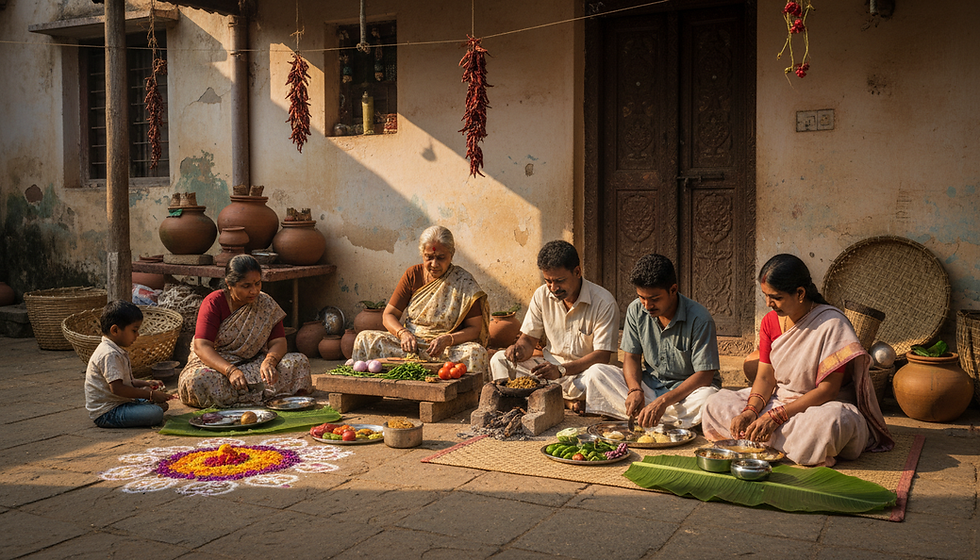
Rituals turn meals into meaning
Food plays a central role in rituals because it is both practical and symbolic. It feeds the body, but it also marks a moment.
A festival sweet is not only dessert. It signals time, season, and belonging. Modak during Ganesh Chaturthi, seviyan during Eid, plum cake around Christmas, til-gud near Makar Sankranti, and pongal during harvest celebrations all carry meanings that go beyond taste.
Food also marks life events. Births, weddings, housewarmings, funerals, fasts, and community gatherings each come with rules, habits, and expectations. Some foods are avoided. Some are required. Some must be shared.
These customs differ across regions and communities, but one idea stays common: food can make an occasion feel complete.

Ritual food also teaches patience. Sweets are shaped by hand. Pickles sit in the sun. Batter ferments overnight. Lentils soak. Spices roast slowly. These acts slow people down and connect them to time in a physical way.
In a world of quick delivery and ready-to-eat packets, ritual cooking reminds us that some foods are valued because of the care they ask for.
Street food shows culture in motion
Street food is one of the clearest signs of a living food culture. It adapts fast. It responds to workers, students, travellers, markets, and changing tastes.
A street vendor has to understand flavour, speed, price, and crowd preference. That balance produces some of the most loved foods in India: vada pav, chaat, kathi rolls, momos, jalebi, bhutta, dosa, pav bhaji, egg rolls, kebabs, and countless regional snacks.
Street food is not just about convenience. It creates public life. People gather around a cart, eat standing up, debate which stall is best, and return to the same vendor for years. The food becomes part of a route, a neighbourhood, and a routine.
It also shows how cultures meet. A dish may carry influences from trade, colonial history, migration, local produce, and modern demand. Momos, for example, moved across regions and changed with chutneys, fillings, and frying styles. Chaat changes from city to city, yet it keeps its love for crunch, spice, tang, and sweetness.
Street food keeps tradition flexible. It proves that culture does not survive by staying frozen. It survives by being cooked again and again in new settings.
Everyday meals matter as much as festive dishes
When people speak about food culture, they often mention famous dishes. Biryani, dosa, butter chicken, rogan josh, dhokla, appam, fish curry, chole bhature, and misal pav get plenty of attention. They deserve it, but daily food tells an equally important story.
The everyday thali, lunchbox, or tiffin shows how people actually live. It reflects budget, time, work, climate, and health preferences. A simple meal of rice, dal, sabzi, curd, and pickle may not look dramatic, but it holds nutritional wisdom built over generations.
Many Indian meals balance grains, pulses, vegetables, dairy, spices, fats, and fermented foods. The exact mix changes by region and household. Some homes eat rotis and sabzi. Others eat rice and fish curry. Some rely on millet rotla, curd, and onion. Others eat kanji, idli, upma, khichdi, or sattu.

These meals may seem ordinary because they are repeated. Yet repetition is the point. Food culture is built through habits, not only celebrations.
A family that eats curd rice in summer, khichdi during illness, or bajra roti in winter is following a food logic shaped by season and comfort. Such choices may not be written in cookbooks, but they guide daily life.
Migration changes the plate without breaking the bond
When people move, food moves with them. A person may leave a village, town, or country, but they often carry flavours in memory. They look for familiar spices, recreate dishes with available ingredients, and build new food habits.
Migration can create surprising versions of old dishes. A family in Delhi may make a coastal curry with packet coconut milk. A student in Bengaluru may cook rajma in an electric cooker. An Indian household abroad may use local greens in place of methi or amaranth. The result may not match the original exactly, but it keeps the emotional link alive.
Restaurants, community kitchens, regional food festivals, and small home businesses also help migrants maintain food ties. In many cities, certain neighbourhoods become known for particular cuisines because communities cook, sell, and share what they know.
This process also creates exchange. People taste food from other regions and add it to their own routine. A person who grew up with parathas may come to love idli for breakfast. Someone raised on rice may begin to enjoy thepla while travelling. The plate expands.
Food culture is also about power and access
Food can comfort, but it can also reveal inequality. Who cooks? Who eats first? Who gets the best portion? Which foods are seen as “refined” and which are dismissed as poor people’s food? These questions matter.
Many traditional foods linked to farming, labouring, Adivasi communities, Dalit communities, fisherfolk, pastoral groups, and home cooks have not always received respect in mainstream food spaces. Millets, wild greens, fermented foods, dried fish, offal, local tubers, and foraged ingredients have long histories, even when they were ignored by elite dining.
Food writing and food media have a responsibility to widen the frame. A cuisine is not only its restaurant-friendly dishes. It also includes the foods cooked under pressure, with skill, thrift, and deep knowledge of local resources.
Respecting food culture means respecting the people who carry it.
That includes farmers who grow ingredients, vendors who feed cities at low cost, home cooks who hold family memory, and communities whose food knowledge has often been overlooked.
The future of food culture is already cooking
Food culture keeps changing. Climate shifts, urban life, online recipes, food delivery, travel, changing work hours, and health concerns all affect what people eat.
Some changes create loss. People may forget seasonal foods, local grains, slow methods, or regional names for ingredients. Younger cooks may know global dishes but not the everyday recipes of their own homes.
Other changes create renewal. Millets have returned to many kitchens. Fermentation has gained fresh interest. Regional cookbooks, local food walks, and home chefs have helped people rediscover lesser-known dishes. More diners now ask where ingredients come from and who made them.

The best way to protect food culture is not to treat it like a museum piece. Cook it. Share it. Ask elders how they made something. Learn the names of local vegetables. Buy from markets. Taste with curiosity. Write recipes down, but also watch hands at work.
Food culture lives when people use it.
A simple way to eat with more attention
Food culture can feel like a huge subject, but it starts with small acts. The next time a familiar dish appears on the table, pause for a moment and ask a few questions.
Where did this ingredient come from?
Who taught this recipe to the cook?
Is this dish linked to a season, festival, or place?
What changed from the older version?
Who else makes it differently?
These questions turn a meal into a story. They help people see food as more than taste or trend. They show how deeply a dish can hold history, labour, emotion, and identity.
A culture does not live only in monuments, books, or museums. It lives in the sound of tempering spices, the smell of rice just cooked, the careful folding of a dumpling, the passing of pickle across a table, and the generous question, “Have you eaten?”


Comments